






Unique Reptile Parties and Shows
Snakes, Lizards, Giant Tortoises and Crocs
07792491044

BURMESE PYTHON
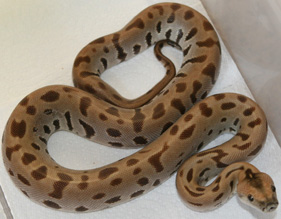 The Burmese Python Latin name molurus bivittatus is the largest subspecies of the
Indian Python and one of the 6 largest snakes in the world, native to a large variation
of tropic and subtropic areas of Southern- and Southeast Asia. They are often found
near water and are sometimes semi-aquatic, but can also be found in trees. Wild individuals
average 3.7 metres (12 ft) long, but may reach up to 5.74 metres (19 ft).
The Burmese Python Latin name molurus bivittatus is the largest subspecies of the
Indian Python and one of the 6 largest snakes in the world, native to a large variation
of tropic and subtropic areas of Southern- and Southeast Asia. They are often found
near water and are sometimes semi-aquatic, but can also be found in trees. Wild individuals
average 3.7 metres (12 ft) long, but may reach up to 5.74 metres (19 ft).
Burmese Pythons are dark-coloured snakes with many brown blotches bordered in black down the back. The perceived attractiveness of their skin pattern contributes to their popularity with both reptile keepers and the leather industry. The pattern is similar in colour, but different in actual pattern to the African Rock Python (Python sebae), sometimes resulting in confusion of the two species outside of their natural habitats.
In the wild, Burmese pythons grow to 3.7 metres (12 ft) on average, while specimens of more than 4 metres (13 ft) are uncommon. In general, individuals over 5 metres are rare. The record maximum length for Burmese Pythons is held by a female named "Baby", that lived at Serpent Safari, Gurnee, Illinois for 27 years. Shortly after death, her actual length was determined to be 5.74 metres (18 ft 10 in). Widely published data of specimens that were reported to have been even several feet longer are not verified. There are dwarf forms on Java, Bali and Sulawesi. At Bali they reach an average length of 2 metres (6.6 ft) and on Sulawesi they achieve a maximum of 2.5 metres (8.2 ft).
The Burmese Python is found throughout Southern- and Southeast Asia including Eastern India, Nepal, Western Bhutan, Southeast Bangladesh, Myanmar, Thailand, Laos, Cambodia, Vietnam, Northern continental Malaysia, far southern China (Fujian, Jiangxi, Guangdong, Hainan, Guangxi and Yunnan), Hong Kong, and in Indonesia on Java, Southern Sulawesi, Bali and Sumbawa. This python is an excellent swimmer and needs a permanent source of water. It can be found in grasslands, marshes, swamps, rocky foothills, woodlands, river valleys, and jungles with open clearings. They are good climbers and have prehensile tails.
Burmese Pythons are mainly nocturnal rainforest dwellers. When younger they are equally at home on the ground and in trees, but as they gain girth they tend to restrict most of their movements to the ground. They are also excellent swimmers, being able to stay submerged for up to half an hour. Burmese Pythons spend the majority of their time hidden in the underbrush. In the northern parts of its range, the Indian python may brumate for some months during the cold season in a hollow tree, a hole in the riverbank or under rocks. Brumation is biologically distinct from hibernation. While the behaviour has similar benefits, specifically to endure the winter without moving, it also involves preparation of both male and female reproductive organs for the upcoming breeding season. There is controversy over whether the Burmese subspecies is able to brumate, and it is believed by experts to be unable to distinguish between a slight chill and dangerous cold weather.
Burmese Pythons breed in the early spring, with females laying clutches which average 12–36 eggs in March or April. She will remain with the eggs until they hatch, wrapping around them and twitching her muscles in such a way as to raise the ambient temperature around the eggs by several degrees. Once the hatchlings use their egg tooth to cut their way out of their eggs, there is no further maternal care. The newly hatched will often remain inside their egg until they are ready to complete their first shedding of skin, after which they hunt for their first meal.
Burmese Pythons have become a problem in the Florida Everglades where owners have released them into the wild & many escaped during Hurricane Andrew which destroyed a Python breeding facility & led to many escapees from homes. They have had a devastating effect on the natural wildlife found in the Everglades, where they have had a major impact on populations of Opossums, Racoons & White Deer. They have even been seen eating Alligators.
Like all snakes, Burmese Pythons are carnivorous. Their diet consists primarily of appropriately-sized birds and mammals. The snake uses its sharp rearward-pointing teeth to seize its prey, then wraps its body around the prey, at the same time contracting its muscles, killing the prey by constriction. They are often found near human habitation due to the presence of rats, mice and other vermin as a food source. However, their equal affinity for domesticated birds and mammals means that they are often treated as pests. In captivity their diet consists primarily of commercially-available, appropriately-sized rats, and graduates to larger items such as rabbits and poultry as they grow. Exceptionally large pythons may even require larger food items such as pigs or goats, and are known to have attacked and eaten alligators and adult deer in Florida, where they are an invasive species.